Back in the f*ckin' rooms again- The Backrooms (2026) Review

Have you ever had a falling out with someone in a place you don't visit often? An old, worn down hotel that you can tell was once a Shining symbol of its era comes to mind for me. Or an ikea. Well, Kane Parson's The Backrooms captures that feeling perfectly; how an ordinary space can become distorted beyond comprehension. How the winding corridors and aisles become an uncanny maze, which isn't helped by your jumbled emotional state. Then again, it becomes a mirror of your mind. One that reflects the horrors of everyday life back at you, your struggles and gripes. It forces you to become existentially philosophical at 2pm on a Wednesday instead of the usual 3am.
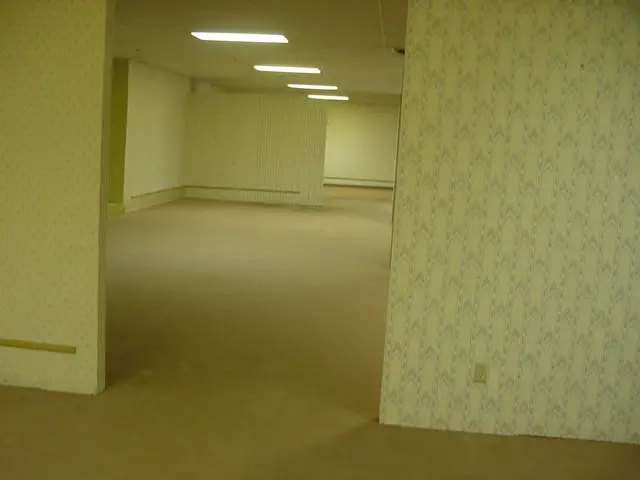
Where did these rooms come from though? If you're online, you might have seen either Parsons’ web series which led to the creation of this film (highly recommend if you haven’t seen it before, it scratches the found footage itch the film leaves you with perfectly), or images of liminal spaces. These call back to the idea of the backrooms which originated on a 4chan thread back in ye old 2019. It was based on a fake urban legend which accompanied a photograph taken in a building under construction. The image was eerie but familiar in a deja vu kind of way. It became addictive to spot similar places, spurred on by a need to identify this sickly sense of belonging, something that becomes an interesting point in Parsons' film.
Clark (Chiwetel Ejiofo) is a striking character from the beginning, assumedly trying to work on his issues in therapy with Dr Mary Kline (Renate Reinsve). She has her own familial trauma to deal with (as well as a healthy dose of social anxiety), yet clearly wants to help Clark and those around her. You know, despite her unsettling therapy book and accompanying cassettes, which felt like our equivalent of “17 hour healing vibrational energy chakra” youtube videos. You do find yourself rooting for these characters though, and Clark’s twist is one that remains shocking yet understandable. It doesn’t attempt to trick the viewer, refraining from making them feel like an idiot for not seeing his chosen path sooner. Now, spoilers duh, but Clark’s inability to accept change as a common factor of life hits pretty close to home for a lot of audiences. His decision to live in the backrooms, an unchanging, detached environment, is one which reflects his suppressed emotional state. He chooses to blame everyone except himself for the shitshow that is his life, and honestly? That’s an incredibly fitting topic for an era where we rush to flood other peoples’ lives with useless opinions through the internet.
What really stands out about this film is its ability to perfectly blur the lines between practical filming and VFX. You cannot tell when a shot filmed in a physical set ends and where the extended VFX rooms begin. It’s incredible, a masterful way of blending digital effects into the found footage genre in a realistic fashion. The set design draws from both the original inspiration image and web series, as well as the new script lore. While the idea of the fungus from the original series was intriguing, the idea that the entities are misremembered just as the furniture and buildings are is gripping as hell. How do the rooms choose who to create? Is there a reason for their different designs? Why are some violent and some aren’t? Well the violence of one in particular is probably a reflection of Clark’s anger issues and unstable emotional state. Yet, the main character of the film really is the setting itself. The yellow walls reminded me so distinctly of Charlotte Perkins Gilman’s short story The Yellow Wallpaper (1892), a comparison which I vaguely remember being brought up years ago when the series first started. I wonder why we keep coming back to yellow as an unsettling sign amidst the ordinary, as a symbol of mental deterioration under extreme circumstances? It’s probably because the usually joyful colour when overused can literally cause eyestrain and fatigue, as well as how it’s the go-to colour for warning signs. Two quotes from the novel which might as well be describing the backrooms are “But I am here, and no person touches this paper but me—not alive!", and “It is so pleasant to be out in this great room and creep around as I please”. The unnamed narrator of the story is trapped in an isolated nursery, while Clark and the others find themselves trapped in an endless, monotonous and similarly solitary maze. The yellow walls are a cage, but one that becomes more horrifying in the film when we realise Clark would rather stay in that cage, where he believes he has complete control. Where he believes nothing can change, unlike in his real everyday life. Both characters’ descents into madness, their minds altered by the places they’re confined to, aligns them with the creatures they seem to face. The narrator by the end associates herself with the creepy woman she believes is trapped beyond the wallpaper, while Clark thinks he is at peace with the backrooms once it creates an entity based on the mis-rememberance of his pirate persona.
While I will be rewatching this film with friends sometime (it's perfect for the slasher summer/ summerween vibes I'm chasing), there are a few things that threw me out of the loop while watching. For one, the pacing is a little off. The end chase sequence feels anticlimactic to say the least. You can imagine each pause Mary (Renate Reinsve) takes is supposed to build more of the suspense we've come to adore. Instead it feels forced and a little messy. My hope for her escape ebbed away as she stood staring at the Clark entity, as it attempted to grab her through a narrow space for the 7th time. Similarly, the continuity of her injured leg feels disparate as she struggles to get away. She barely makes it through a small door because of the pain, only to stand up perfectly fine and edge across a narrow ledge, but then struggles up some steps at a snail's pace on her hands and knees. I know stairs can be a nightmare, but come on, you were scaling that ledge like Lara Croft a moment ago. Oh and on top of all of that, Phil (Mark Duplass), the scientist we meet from Async (a used-to-be MRI manufacturer turned interdimensional lab à la Stranger Things) is someone who has potential- if we remembered his face. His introduction through watching the security footage of Clark first wandering the backrooms only shows his face (in daunting dingy lighting) for about 5 seconds. That is not enough time to take note of him as a recurring character. He's given more screentime when he recognises Clark from a commercial later on, but viewers who didn't catch him the 1st time around are left wondering who this guy hosting family movie night is. It's a little pet peeve because he seems like an interesting character, clearly torn between his empathetic nature and his boss' unseen presence when talking to Mary in the end. Instead though I'm left wondering about the potential rather than what was actually delivered.
I’m also left reeling though by the famous talent from the horror industry that worked on this film- With James Wan (Saw, Insidious, The Conjuring, I could go on), Jason Blum (Blumhouse) and Osgood Perkins (Longlegs, The Monkey). Let's not forget Robert Bobroczkyi’s terrifying performance as the Clark entity, an actor who I have a feeling Guillermo Del Toro will be casting in at least one of his future features. Found footage films are undoubtedly a gripping staple of the horror genre, and I have a feeling Parsons has just sparked a wave of renewed interest in the technique and genre at large. I plan to delve into it in quite a lot of my own projects, as I'm sure a lot of other aspiring filmmakers will too after seeing the success of this spine-tingling world.

Comments